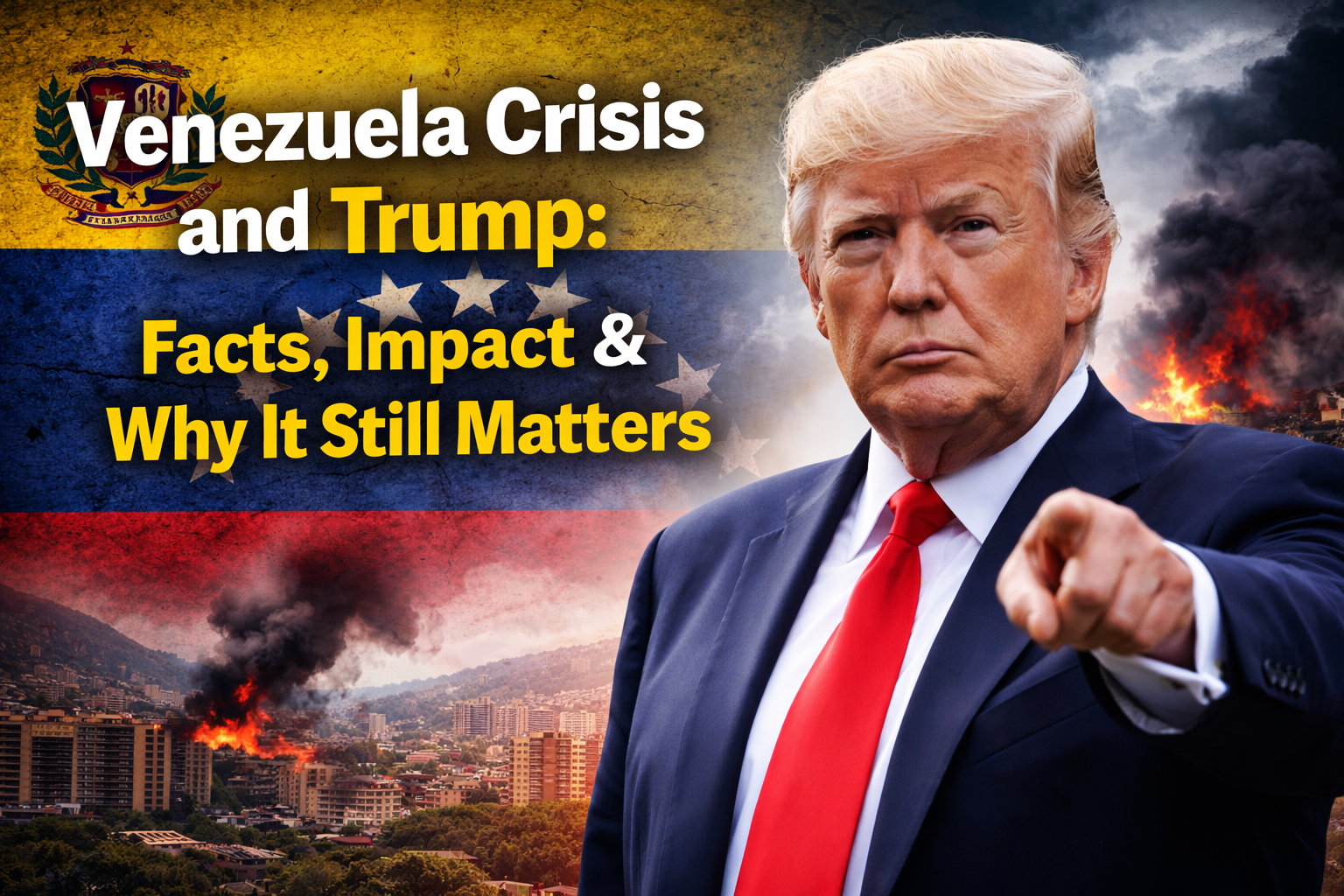
Venezuela Crisis and Donald Trump: What Is the Real Issue and Why It Still Matters Globally
The Venezuela crisis has remained one of the most complex geopolitical issues of the last decade, and former US President Donald Trump played a significant role in shaping America’s hardline policy toward the South American nation. Even years after his presidency, the “Venezuela matter” continues to influence US foreign policy debates, global oil markets, and Latin American politics.
But what exactly was Trump’s approach to Venezuela, what were the real facts behind it, and why does it still matter today? Here is a fact-checked and balanced analysis.
Background: Venezuela’s Political and Economic Crisis
Venezuela, once one of the world’s richest oil-producing countries, has been facing a deep economic collapse, hyperinflation, political instability, and humanitarian crisis since the mid-2010s. Shortages of food, medicines, and basic services forced millions of Venezuelans to migrate to neighboring countries.
The crisis intensified after Nicolás Maduro continued as president amid disputed elections, which several Western nations, including the United States, refused to recognize as free and fair.
Donald Trump’s Venezuela Policy: Key Facts
During Donald Trump’s presidency (2017–2021), the United States adopted its toughest stance ever against the Maduro government. The policy was based on three main pillars:
1. Recognition of Juan Guaidó
In 2019, the Trump administration officially recognized Juan Guaidó, the head of Venezuela’s National Assembly, as the country’s interim president. This move was supported by several US allies but rejected by Russia, China, Cuba, and others.
Fact check:
Guaidó never took control of the Venezuelan state or military, and Maduro remained in power throughout Trump’s term.
2. Economic Sanctions and Oil Restrictions
The US imposed strict economic sanctions, especially targeting Venezuela’s oil sector, which is the backbone of its economy. American companies were barred from buying Venezuelan oil, and assets linked to the Venezuelan government were frozen.
Fact check:
Sanctions significantly reduced Venezuela’s oil exports, but experts agree that the country’s economic problems began before these sanctions due to mismanagement and corruption.
3. “All Options on the Table” Statement
Donald Trump repeatedly stated that “all options are on the table,” including military action. While no military intervention occurred, these statements increased regional tensions.
Fact check:
No direct US military action was taken against Venezuela under Trump.
Why Trump Took a Hard Line on Venezuela
Analysts identify several reasons behind Trump’s aggressive approach:
- Anti-socialist messaging: Trump frequently used Venezuela as an example to criticize socialism, especially during US election campaigns.
- Domestic politics: The policy appealed to Cuban-American and Venezuelan-American voters, particularly in Florida.
- Geopolitical rivalry: Limiting the influence of Russia, China, and Iran in Latin America was a key US objective.
Impact of Trump’s Venezuela Policy
On Venezuela
- Oil revenues dropped sharply.
- The humanitarian situation worsened, though the crisis was already severe.
- The Maduro government remained in power, showing that sanctions alone did not lead to regime change.
On the United States
- The US strengthened its image as a firm opponent of authoritarian regimes.
- Critics argue the policy failed to achieve its main goal: democratic transition.
On Global Oil Markets
With Venezuela holding the world’s largest proven oil reserves, restrictions on its oil exports affected global energy dynamics, especially during periods of rising oil prices.
What Changed After Trump Left Office?
After Trump, US policy toward Venezuela saw tactical adjustments but no complete reversal. Some sanctions were eased conditionally to encourage democratic negotiations, but Maduro remains under pressure.
Key fact:
Despite changes in tone, the core US demand—free and fair elections—has remained consistent across administrations.
Why the Venezuela–Trump Issue Still Matters Today
- Energy security: Venezuela’s oil potential remains crucial in times of global energy uncertainty.
- Migration crisis: Millions of Venezuelan migrants continue to affect regional stability.
- US foreign policy debate: Trump’s Venezuela strategy is often cited in discussions about sanctions, regime change, and diplomacy.
- 2026–2028 political narratives: Venezuela is still used as a reference point in debates on socialism vs capitalism.
Conclusion: Facts Over Rhetoric
The “Venezuela matter” under Donald Trump was defined by maximum pressure, strong rhetoric, and limited diplomatic engagement. While the policy succeeded in isolating the Maduro government internationally, it did not bring immediate political change inside Venezuela.
Fact-based analysis shows that Venezuela’s crisis is the result of long-term structural problems combined with external pressure, not a single leader or policy. As global politics evolve, the legacy of Trump’s Venezuela strategy continues to shape how nations respond to political crises worldwide.