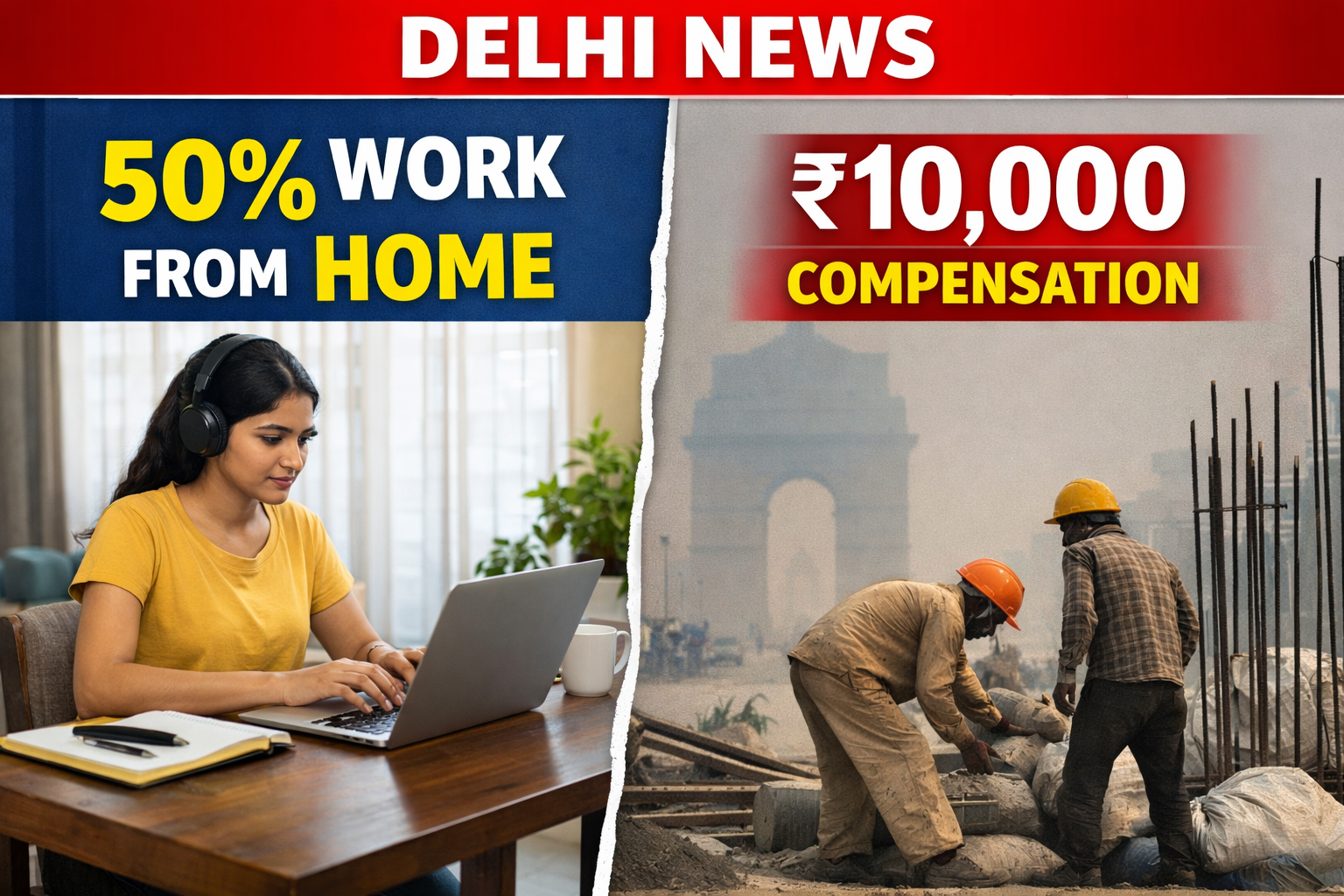
Delhi Government Allows Work From Home for 50% Staff; ₹10,000 Compensation Announced for Affected Construction Workers –
Breaking News Delhi: In a major step to curb rising air pollution in the national capital, the Delhi government has allowed 50 percent work from home (WFH) for employees of all government and private institutions. The decision comes as part of strict measures enforced under the Graded Response Action Plan (GRAP) Stage 3 and Stage 4, which are currently in effect due to hazardous air quality levels in the city.

At the same time, Delhi Labour Minister Kapil Mishra announced financial relief for construction workers affected by the restrictions. Registered construction workers who have become unemployed due to the GRAP curbs will receive a compensation of ₹10,000, providing much-needed support to daily wage earners hit hardest by the pollution-control measures.
50% Work From Home Mandate to Reduce Pollution Exposure
With air quality deteriorating to severe levels, the Delhi government has instructed both government offices and private sector organizations to allow 50 percent of their workforce to operate from home. The move is aimed at reducing vehicular traffic, lowering emissions, and minimizing public exposure to toxic air.
Officials believe that reducing daily commuting will significantly help in controlling pollution levels while ensuring that essential work continues without major disruption. The work-from-home order applies across sectors, including corporate offices, institutions, and administrative departments, unless operational needs require physical presence.
Experts have welcomed the decision, stating that hybrid working models are effective in emergency environmental situations and can provide immediate relief to the city’s pollution.
GRAP Stage 3 and 4: Why Restrictions Were Necessary
The Graded Response Action Plan (GRAP) is a set of emergency measures implemented when air pollution crosses critical thresholds. Under Stage 3 and Stage 4, strict curbs are imposed, including:
- Ban on construction and demolition activities
- Restrictions on non-essential vehicular movement
- Closure or limitation of certain industrial operations
- Promotion of work from home to reduce emissions
These measures, though essential for public health, have had a direct impact on construction workers and daily wage earners who depend on active projects for their livelihood.
₹10,000 Compensation for Unemployed Construction Workers
Recognizing the economic distress caused by the construction ban, Labour Minister Kapil Mishra announced that registered construction workers affected by GRAP Stage 3 and 4 restrictions will receive ₹10,000 as compensation.
This financial assistance will be provided to workers who are officially registered with the Delhi government and have lost employment due to the temporary halt in construction activities. The compensation aims to help workers to meet essential expenses such as food, rent, and healthcare during the restriction period.
According to officials, the government has directed concerned departments to ensure that the relief amount is disbursed quickly and transparently to eligible beneficiaries.
Government’s Focus on Health and Livelihood Balance
The Delhi government stated that while pollution control remains the top priority, it is equally important to protect the livelihoods of vulnerable workers. The dual approach of allowing work from home for office staff and offering direct financial aid to construction workers reflects an effort to balance public health concerns with economic stability.
Labour unions and social welfare groups have largely accepting the compensation announcement, calling it a timely intervention. However, they have also urged authorities to ensure smooth registration and fast payments so that no eligible worker is left out.
Impact on Offices, Businesses, and Employees
The work-from-home directive is expected to impact thousands of offices across Delhi. Many private companies had already adopted flexible working arrangements, and the government order formalizes the process during the GRAP enforcement period.
Employees have expressed relief, as reduced commuting lowers health risks associated with prolonged exposure to polluted air. Schools, hospitals, and essential services, however, will continue to function as per separate guidelines.
What Happens Next?
The continuation of these measures will depend on air quality trends in the coming days. Authorities are closely monitoring pollution levels, and restrictions may be relaxed or tightened accordingly.
The Delhi government has urged citizens to cooperate with the guidelines, limit outdoor activities, and follow advisories issued by health and environmental agencies.
Conclusion
The decision to allow 50 percent work from home and provide ₹10,000 compensation to unemployed construction workers highlights Delhi government’s proactive response to the ongoing air pollution crisis. While GRAP Stage 3 and 4 restrictions are challenging, these measures aim to protect both public health and economic well-being.
As pollution continues to be a recurring challenge for the capital, such policy interventions underline the need for long-term solutions alongside immediate relief efforts.