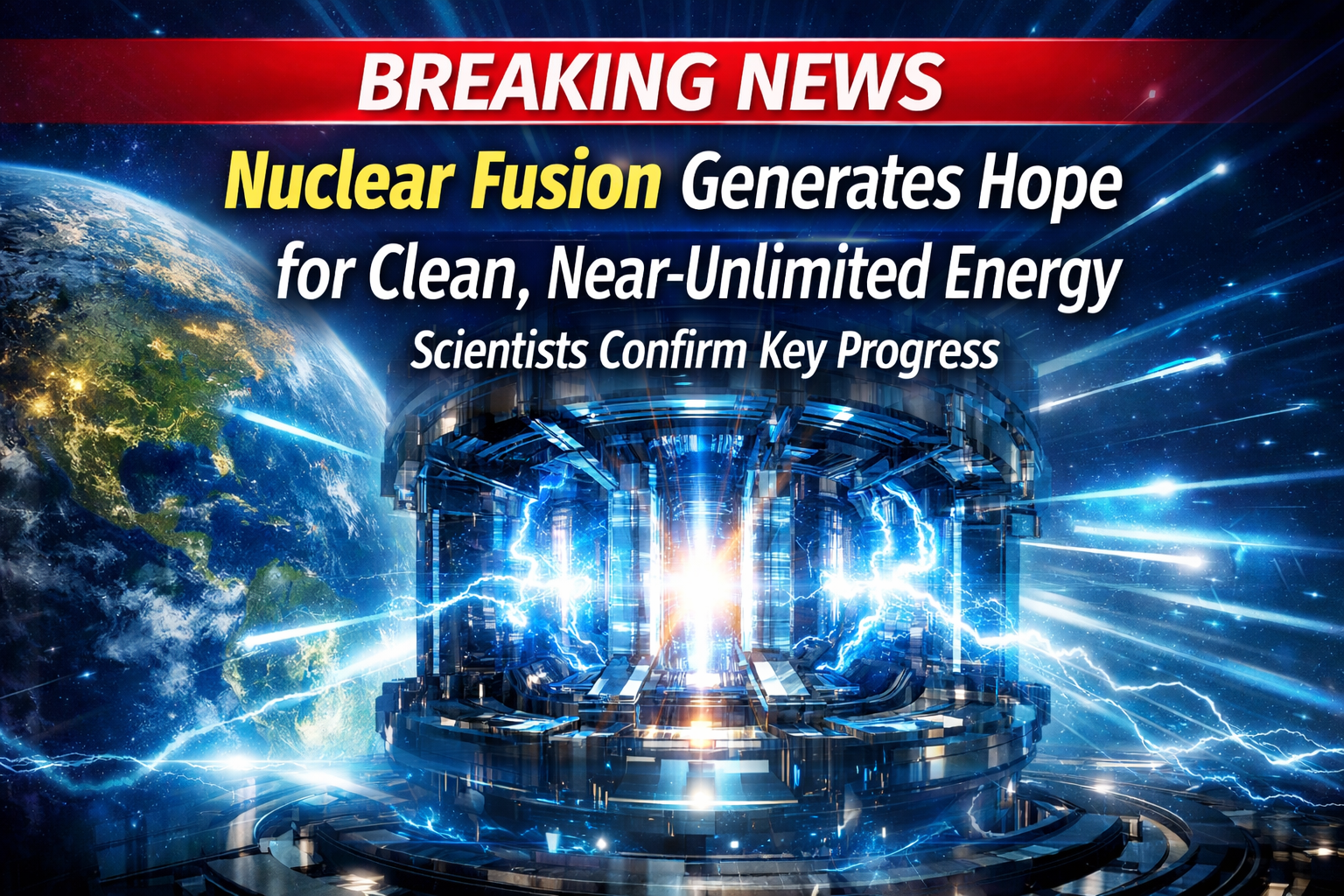
Breaking News: Nuclear Fusion Raises Hope for Clean, Near-Unlimited Energy, Scientists Confirm Key Progress
As the world struggles with rising electricity demand, climate change, and dependence on fossil fuels, a new scientific development is drawing global attention. Nuclear fusion, often described as the energy source of the future, has shown confirmed progress that could eventually transform how the world generates power.
Recent scientific experiments have strengthened hopes that nuclear fusion may one day provide clean, safe, and nearly unlimited energy.
What Is Nuclear Fusion?
Nuclear fusion is the process in which two light atomic nuclei combine to form a heavier nucleus, releasing a massive amount of energy. This is the same reaction that powers the Sun and stars, producing light and heat naturally.
Unlike traditional nuclear fission used in current power plants, fusion:
- Does not emit carbon dioxide
- Produces very little radioactive waste
- Carries a much lower risk of large-scale accidents
Because of these advantages, scientists consider fusion one of the most promising clean energy technologies.
What Have Scientists Achieved Recently?
Researchers have confirmed that controlled fusion experiments have reached an important milestone known as “net energy gain.” This means that, in laboratory conditions, the fusion reaction produced energy equal to or greater than the energy used to trigger it.
This achievement is scientifically verified, not a rumor. However, experts clarify that this success is still limited to experimental facilities and not yet ready for commercial electricity production.
Why Is Fusion Called “Near-Unlimited Energy”?
Fusion uses hydrogen-based fuel, such as deuterium, which is widely available in seawater. According to experts, this fuel supply could meet global energy needs for thousands of years.
Because the fuel is abundant and the process is clean, nuclear fusion is often described as:
- A long-term solution to the energy crisis
- A future alternative to coal, oil, and gas
- A major breakthrough for climate protection
Will Fusion Power Reach Homes Soon?
Despite the excitement, scientists urge caution. Fusion power plants face major technical challenges, including maintaining temperatures above 150 million degrees Celsius and building durable reactors.
Experts estimate that commercial fusion electricity may still take 10 to 20 years to become a reality. Until then, continued research and investment are essential.
What Does This Mean for India and the World?
Many countries, including India, the United States, Japan, and European nations, are investing heavily in fusion research. If successful, fusion energy could:
- Reduce electricity costs
- Cut pollution and carbon emissions
- Decrease dependence on imported fuels
- Support sustainable economic growth
Conclusion
The news about nuclear fusion is confirmed and credible, but it should not be misunderstood as an immediate solution. While unlimited clean energy is not yet available, the latest progress marks a significant step toward a cleaner and more secure energy future.
For now, nuclear fusion remains one of the most closely watched scientific advancements — with the potential to redefine global energy systems in the decades ahead.